Tesla’s lineup of electric cars ranges from lightweight sedans to hefty SUVs, and understanding their weights provides insight into their design and performance. Electric vehicles tend to be heavier than similar gasoline cars due to large battery packs and electric motors. J.D. Power, a renowned consumer analytics firm known for its automotive ratings, notes that “Tesla cars are known for their heavyweight due to their battery packs and electric motors”. In the United Arab Emirates market, Tesla currently offers four models — the Model 3, Model Y, Model S, and Model X — each with a different weight profile. Focusing on the base (entry-level) version of each, this article compares how much these Tesla models weigh and what contributes to the differences.
Tesla Model 3 (Sedan)
The Tesla Model 3 is the smallest and lightest of the Tesla family available in the UAE. The base Model 3 (RWD) has a curb weight of around 1,765 kg (approximately 3,890 lbs). This relatively lighter weight is due to its smaller battery (around 50–60 kWh in the Standard Range trim) and single electric motor. Despite being the lightest Tesla, the Model 3’s mass is still substantial for a compact sedan — largely because of the battery pack that sits under the floor. For context, its dual-motor Long Range version weighs about 1,830 kg (4,034 lbs) and the Performance trim around 1,836 kg (4,048 lbs). The base Model 3’s lower weight helps it achieve brisk acceleration and efficient energy consumption, making it an ideal entry-level Tesla.
Tesla Model Y (Compact SUV)
The Tesla Model Y is a crossover SUV built on a similar platform as the Model 3, but it is heavier due to its larger body and battery. The base Model Y (RWD) in the UAE has a curb weight of roughly 1,928 kg (about 4,250 lbs). This extra ~150–160 kg over the Model 3 comes from the Model Y’s taller, more spacious SUV design and a larger battery capacity (Standard Range models use ~55 kWh, while Long Range versions use ~75–82 kWh batteries). The dual-motor Model Y Long Range and Performance trims both weigh around 2,000 kg (~4,416 lbs), since both carry dual motors and the same high-capacity battery. In practical terms, the Model Y’s higher weight gives it a slightly higher center of gravity and marginally higher energy consumption than the Model 3, but it also offers greater cargo space and available seating for up to seven. Even as a “compact” SUV, the Model Y’s weight approaches two tones, reflecting the influence of its electric powertrain components.
Tesla Model S (Full-Size Sedan)
The Tesla Model S is a larger luxury sedan and accordingly weighs more than the smaller models. The current base Model S (dual-motor Long Range) weighs approximately 2,089 kg (about 4,600 lbs) as a curb weight. This makes it one of the heavier sedans on the road. The Model S’s weight stems from its large 100 kWh battery pack and robust dual-motor all-wheel-drive system, along with a spacious body built for comfort and safety. By comparison, the high-performance Model S Plaid (tri-motor) is slightly heavier, around 2,183 kg, due to the addition of a third motor and associated hardware. In everyday driving, the Model S’s ~2.1-ton mass is managed by adaptive air suspension and a low center of gravity (thanks to the floor-mounted battery), which help maintain agility. Owners note that the Model S “handles well despite its weight and size,” highlighting Tesla’s engineering to mitigate the impact of its heavy components (as reported by Car and Driver, a reputable automotive magazine). The substantial weight also contributes to a solid, planted feel on highways and top-tier safety ratings, but it does mean the car carries a lot of momentum on the move.
Tesla Model X (Full-Size SUV)
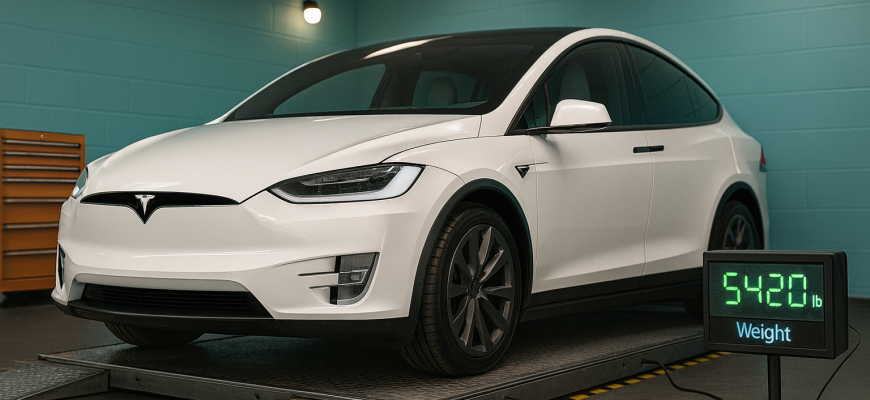
The Tesla Model X is the largest and heaviest vehicle in Tesla’s lineup. This full-size SUV’s base Model X (dual-motor Long Range) version has a curb weight of about 2,335 kg (over 2.3 tonnes, which is ~5,150 lbs). In fact, the Model X Long Range weighs 5,185 pounds, making it the heaviest of the Tesla models. Its weight is a result of a massive battery (also around 100 kWh), dual electric motors, a large SUV body structure, and features like the Falcon Wing rear doors mechanism. The Model X Plaid trim (with three motors) is heavier still, weighing around 2,445 kg (5,390 lbs), primarily due to the additional motor and associated drivetrain components. The Model X’s ~2.3–2.4 ton weight gives it a commanding presence on the road and tremendous stability when cruising, especially with its low-mounted battery pack keeping the center of gravity low for an SUV. However, drivers should be mindful of this weight in terms of braking distances and tire wear. Notably, despite its weight, the Model X can tow up to 2,300 kg — a capability aided by its powerful motors. Overall, the Model X exemplifies how heavy an electric SUV can be when maximizing space and performance.
Comparing Tesla Models: Weight Table
The table below compares the approximate curb weights of Tesla base models (entry-level versions) currently offered in the UAE market:
| Tesla Model (Base Trim) | Curb Weight (kg) | Curb Weight (lbs) |
|---|---|---|
| Tesla Model 3 RWD (sedan) | ~1,765 kg | ~3,890 lbs |
| Tesla Model Y RWD (SUV) | ~1,928 kg | ~4,250 lbs |
| Tesla Model S Long Range (sedan) | ~2,090 kg | ~4,600 lbs |
| Tesla Model X Long Range (SUV) | ~2,335 kg | ~5,150 lbs |